Wednesday, March 1, 2017

Social Media Monitoring Project Part 1: Ben and Jerry's Pint Slices


Who doesn't love ice cream? More importantly who doesn't love Ben and Jerry's? Ben and Jerry's ice cream has revolutionized ice cream. From their wacky, "euphoric" flavors, to their frozen yogurt, to cores, and to their newer addition of non-dairy, there is an ice-cream to make almost everyone happy. This month Ben and Jerry's launched their "Think outside the pint" campaign. This campaign turned their well loving ice-cream pints into individual slices. Since it is just the start of this campaign, it is only available in 4 flavors: Americone Dream, Chocolate Fudge Brownie, Chocolate Chip Cookie Dough, Vanilla Peanut Butter Cup. Below is their promo video. Have you seen this video sponsored on Facebook or somewhere else? I first saw it on Facebook, and I do not "like" Ben and Jerry's there. 
This is their newest addition, and only time will tell how the groundswell likes or dislikes it. We have learned that social media is key to marketing. So we need to discover if Ben and Jerry's has used it to their advantage or not. After a company recognizes the groundswell, they need to listen to it, talk with it, and energize it (groundswell).

It seems if Ben and Jerry's listened to the groundswell. Recently, there have been numerous videos online of people slicing pints of ice cream to make ice cream sandwiches (mashable). I remember scrolling through Pinterest and seeing this (see right picture). Ben and Jerry's saw this fad too, and posted their own how to video of how to make an ice cream sandwich.
This video was posted in September of 2016, and has almost 3 million views. Ben and Jerry's does not reply on it's YouTube channel, but to one comment it almost seems like they replied in another way. 
This person wrote what most of us were thinking (besides the fact that this is a pint of ice cream not a gallon). It's a great idea, but what about the extra ice cream? Even though Ben and Jerry's did not reply to this user (or any user on YouTube) they responded to the groundswell, and made something of interest to them. Individually wrapped ice cream sandwiches. Sure, it's not the chocolate chip cookie kind, but it's covered in chocolate... I'd say that's a fair tradeoff. 

Twitter
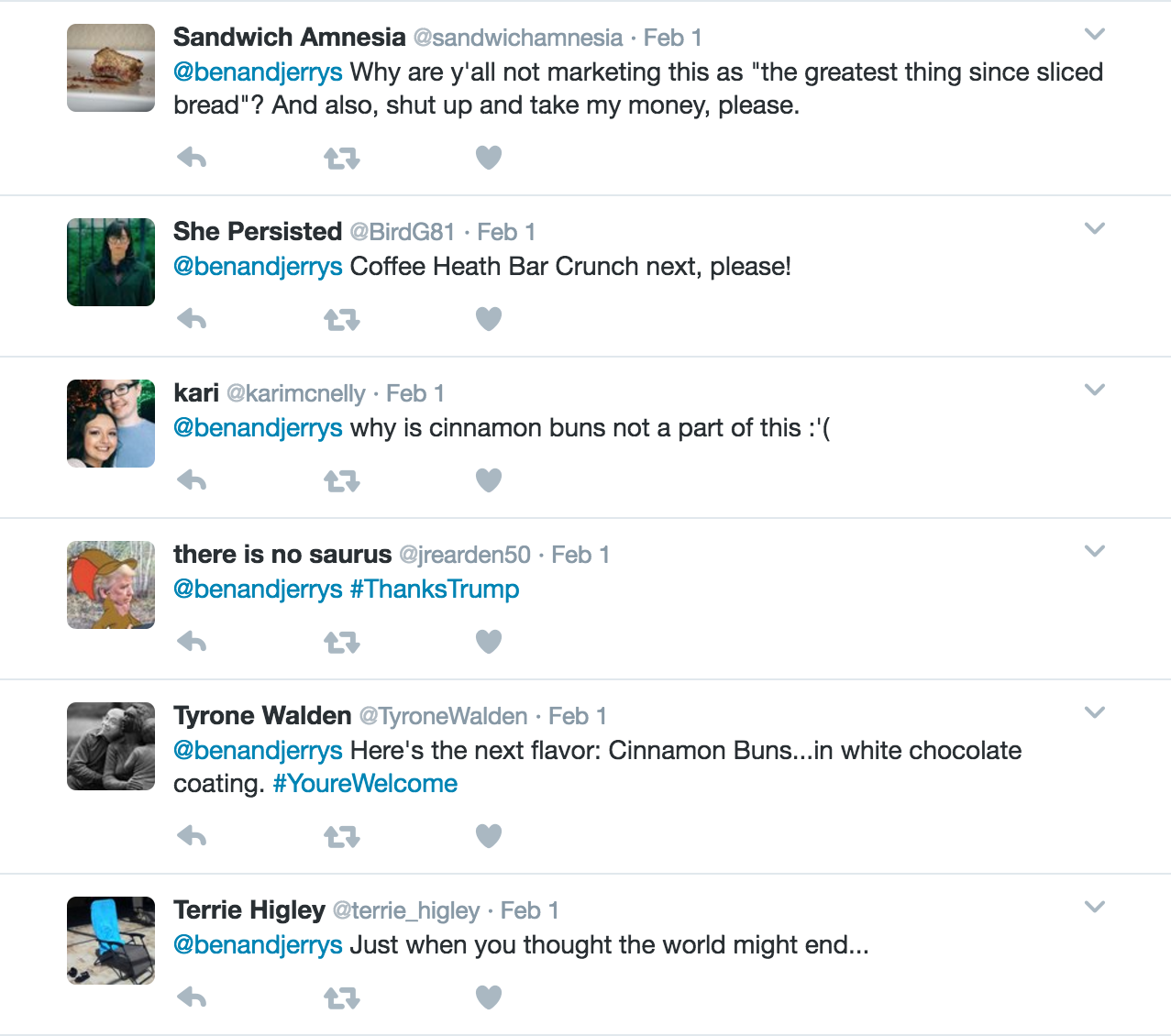
Ben and Jerry's may not respond on their YouTube channel, but they seem very responsive on Twitter. Many of the replies to Ben and Jerry's introducing Pint Slices included: where can they be found, will they be in other countries, if they will be sold in non dairy, if other flavors will be involved in this new way, and a lot of happy people tagging their friends with phrases like "omg" and "I want." Ben and Jerry's did not communicate with the groundswell after the first initial replies. There were some questions that were not answered, like if this would come in non-dairy. 
Here there are some really good opportunities for Ben and Jerry's to talk with the groundswell. The groundswell is voicing their opinions for a flavor they want to see. Ben and Jerry's also did not talk with people who replied with excitement either. If they replied to those people, they would help to energize the groundswell. The overall reaction from the groundswell on Twitter was excitement. The sadness came when it would not be offered in other countries, and when it was not offered in a particular flavor or type (non dairy). However, even with the sadness that is expressed from the groundswell, overall it is still happy and excitement. Other countries want it, so Ben and Jerry's succeeded there. People who want other flavors or kinds, are also still excited about the new product, but want to see it expanded. Ben and Jerry's should listen to what the groundswell wants to make this product even more popular. 

Instagram
Ben and Jerry's does not use Instagram to engage with the groundswell. The groundswell responded in a very similar way on Instagram. They tagged their friends in excitement so their friends could see it too, they wondered about other countries, other flavors, and other types, but ultimately the groundswell loved this new product. With over 150,000 views, and almost 15,000 likes, this post was seen by many.

Facebook
Ben and Jerry's engages with the groundswell the most on Facebook. They talk with, and they energize the groundswell. From liking the comments posted, to responding, to just keeping people excited, they are very active with their groundswell.
The same video, to introduce Pint Slices, that was posted on Twitter and Instagram was also posted on Facebook. It appears that Ben and Jerry's largest following is on Facebook. As you can see, with over 64,000 likes, and over 18,000 shares, this video made its rounds on Facebook. I don't even "like" Ben and Jerry's on Facebook, and it appeared on my timeline multiple times, and many days after. I mentioned that Ben and Jerry's does a better job of interacting with the groundswell on Facebook. Although, they do not answer everyone (it would be extremely difficult with the copious amount of comments), they respond to people who are just showing their excitement, not just asking questions. 
I really liked seeing Ben and Jerry's response to Kel. They acknowledged that they do not have it, they insinuate with that it could be on the way. With more push from the groundswell, it may make Ben and Jerry's move faster to making this product in a non dairy form. 

Social Media Following

Twitter:
Instagram: 
Facebook:

As you can see Ben and Jerry's reaches a large amount of people. Facebook reaches the most, then Instagram, and then Twitter. They reach people locally and globally. From their social media pages, we found the negative (if you can really even call them that) comments are based on the product not coming in certain flavors or types, and it not being available in other countries besides the US. From the way in which Ben and Jerry's responded to the groundswells comments (they can definitely do a better job on Twitter and Instagram), we can see that they are acknowledging people's opinions and hope to satisfy them once they see the product gets going. So the only potential flaws Ben and Jerry's has and could face, is if they do not respond to groundswell and make this product global, in dairy free flavors, and maybe in other flavors as well. 
They interacted and heard the groundswell, now they need to act on it. However, it is clear, especially on Facebook that Ben and Jerry's is doing much more than advertising, and they are talking and interacting with the groundswell. 

Ben and Jerry's interacts well on Facebook, decently on Twitter, and not at all on Instagram. They could use Twitter and Instagram more to help energize their customer base and then ultimately the groundswell.

Now that we looked at some qualitative feedback of Ben and Jerry's Pint Slices, let's take a look at some quantitative data.

Google Trends:

Ben and Jerry's

Ben and Jerry's Pint Slices

From looking at these two graphs we can see the introduction of Pint Slices (February 1st) is what caused both the brand itself, and the product to have a high peak. Since the initial release of the product, the talk about Pint Slices has decreased. Ben and Jerry's have had many peaks and valleys this past month. I would guess that it had to do not only with the release of the Pint Slices, but with the release of new flavors as well.

Meltwater IceRocket:

Ben and Jerry's Pint Slices

Ben and Jerry's Pint Slices Vs Ben and Jerry's

We can see that Meltwater IceRocket is showing a similar phenomenon as Google Trends: that Ben and Jerry's Pint Slices spiked when they were released, and consequently that Ben and Jerry's as a brand spiked as well. Like Google Trends showed, Ben and Jerry's has a lot of peaks and valleys. 

Something else Meltwater IceRocket shows is the amount of blog posts per day. It seems obvious that the brand would have more on its own then the product, but it still does not seem like the Pint Slices are generating much excitement within the groundswell. 

Social Mention:
For each of the following screen shots, Ben and Jerry's Ice Cream is on the right, and Ben and Jerry's Ice Cream Pint Slices is on the left.

Wednesday evening (5pm)


Sunday evening (4pm)

Thursday night (8pm)
From these screenshots it is somewhat difficult to get a true read on the data. Besides Sunday, Ben and Jerry's as a brand seems to be doing well with strength, positive comments and reaching a large number of people. Although the Pint Slices are not generating that much talk, it does seem that the talk they are getting is extremely positive and it appears the passion is growing with time. 

Conclusion:
The Pint Slices seem to be a huge success, even though the quantitative data is not reflecting what the qualitative data is...I feel this could be because Ben and Jerry's did in fact generate excitement within the groundswell, but they do not have as many Creators so this is why it is not reflecting in the quantitative data.


Sunday, February 26, 2017

One Company, Two Brands, Two Completely Different Messages

In class we briefly discussed 
Unilever. How many of y'all had heard of 
Unilever
before class? I personally had no idea about it until recently. However, if I had to guess most of you probably would have heard Axe prior to discussing it in class. The same probably rings true of Dove

Recently, I learned that both Axe and Dove are owned by the same company: Unilever. If you know anything about the two brands, you know that they have two totally different messages for their audience. 
Axe is all about "getting the woman." Just take a look at the description of the Axe brand from Unilever's website:

While Dove has a completely different message. Dove uses real people, not models for their commercials. They are about finding everyone's beauty. Here is what Unilever says about the Dove brand:

So the same company that is making women objects who have no control when they smell Axe (the "Axe Effect" as they call it), is also trying to build women's self esteem through the Dove brand... hmmmm... I see some contradictions do you?


Here is one of Axe's commercials.
There are so many of them and they all have a similar message: if you wear Axe, women will not be able to resist you. 

Below is one of Dove's commercials with the opposite message. Dove's brand has been about embracing women and showing what makes them beautiful. You don't need a certain body type or need to look a certain way to be beautiful, because you are beautiful.
There is a clear conflicting message between the two brands. The groundswell took notice of this. Check out this article posted on US News.
Or one of the other countless blog posts, and articles out there that speaks on this huge contradiction from Unilever. 


This excerpt comes from AdAge, one of the many articles that exist on this controversy. Dove's video above was at the start of their campaign to advocate for real beauty, what everyone has. Even though this was a great campaign, it received flak, because the groundswell noticed this hypocrisy at Unilever. So the groundswell went to work posting about this. And you know what, it seems that Unilever may just have listened. Take a look at one of Axe's newer commercials. 

Axe has begun to change its image. There is a huge difference between this commercial and the other one I posted. This commercial received a lot of positive feedback. 


So it looks like when Unilever listens to the groundswell it works out in their favor. Even though this commercial is appealing to the groundswell, their website still does not reflect this change. They need to fix this or the groundswell will see this was just a front and that Unilever has not really changed.

Do you think Unilever has changed or do you think the Axe commercial was just to appease the groundswell?

Sunday, February 19, 2017

Patagonia Energizing the Groundswell

How many of you have heard of Patagonia? Well, if you haven't I'm genuinely surprised. Patagonia is a privately owned giant in outdoor gear. They strive to do good for the community, environment, and their staff. 


From this mission statement, it is no surprise that Patagonia is known for its transparency. It once posted an ad that encouraged people not to buy one of its jackets because of the damage manufacturing it would cause to the environment. Pretty interesting technique right? Since the company is an advocate of the environment, it only makes sense for them to stay true to that. The purpose of the ad was to encourage customers to think hard if the jacket was something they needed. The ad actually boosted Patagonia’s sales from customers who “would have bought cheaper products from competitors. Patagonia somehow created a rare perception of quality and do-gooder aura that certain people believe is worth a higher price” (Quartz). I mean but what company actually tells you not to buy their product, and then gets more people to buy it? Patagonia is the only one I can think of. This is because they have listened, talked with, and are energizing the groundswell. 

Because of this example of transparency we can see why Patagonia would encourage their customers to share reviews and stories. Patagonia understands the groundswell is who makes their brand what it is, not them. So instead of Patagonia doing all of the talking, they encourage the groundswell to do so. 

Li and Bernoff discuss the idea of energizing the groundswell (Groundswell). They told us how 23% of the groundswell are Creators, one third are Critics, and two thirds are Spectators. Patagonia understood this. They gave the Creators a blog, and the Critics reviews, consequently giving the Spectators somewhere to look. Patagonia also has ambassadors who share the story of what Patagonia means to them- energizing the groundswell. 

Patagonia created a blog called The Cleanest Line. From the description on the right we can see that openness, and transparency is something this company values. Blog posts are posted by anyone from their founder, to their employees, to their ambassadors, to every day people like you and me. On the blogs website, Patagonia gives us guidelines on how to submit a post. The blog is less about the specific products, but is more about Patagonia's brand. Which is why it's perfect for Creators. Patagonia gave Creators who are passionate about Patagonia and what they stand for a platform to share their stories. The posts range in topics: activism, sports, food, and much more. Not only can Creators get in on this blogging, but Critics and Spectators can too. Critics can leave comments on blogs and Spectators can read around.

Patagonia does not regulate the comments, but they do moderate them. Patagonia has this blog, and they, as well as everyone else, are finding out what their brand truly stands for. Li and Bernoff pointed out that the Mini brand has their own culture, Patagonia does as well. Patagonia realized this and provided a forum to energize its groundswell.

Patagonia also adheres to the Critics needs by allowing them to post their thoughts on the products. I went to look at what I consider one of their most popular items... the classic pullover. I mean come on, has anyone actually never seen this jacket before? I know I see it everywhere. Anyway, when looking at the product, in the top right corner you can see the star ratings. To read the comments you can simply click on the starts and it will scroll you down to where they are located. 
The overall rating of this product was a 4.6 with 340 total ratings. From the screenshot above, we can see the groundswell, especially the Critics, are eager to share their input on this jacket. The first post shows just how helpful the groundswell was in helping that customer order her jacket. The Critics did their part and helped others because Patagonia gave them the opportunity to. The cool thing about this rating system is that it has the stars, the explanation, the overall yes I would recommend, or no I would not, a place to scale the fit, and lastly a place where Spectators can acknowledge if a review was helpful or not. 

Since this reviewing system does not appear to have comments, I am wondering if Patagonia has reached out to people who were not satisfied. 

Patagonia saw and understood their groundswell was a culture, and decided to create a forum for Creators to blog, a space for Critics to review, and an overall place for Spectators.

Patagonia energizes the groundswell and has ambassadors who will blog, post, and share the brand. They are also involved in helping to develop the gear for their particular sport.

I know that the more I learn about Patagonia from the groundswell, the more I want to buy their products. Would you buy from Patagonia too? 

Sunday, February 12, 2017

The Fix Fixing It's Social Media Presence

How many of y'all like to go out to eat at restaurants? Ding ding, that's me too. I love going out to eat, trying new restaurants, and of course going back to my favorites.

One of my FAVORITE restaurants, is The Fix, right here in Worcester. If you have ever been there, you can attest to how amazing it really is. From pulled pork nachos, to build your own burgers, and to spiked milkshakes... you really can't go wrong with anything you pick.

Being that I loved the restaurant, I decided to "like" The Fix's Facebook page.

Keep in mind, I am very particular about what I "like" on Facebook for two reasons. One, once I like it, it's available for others to see that I liked it and that then associates me with whatever I liked. Secondly, sometimes after I like something, all I see are posts from that particular thing, and that can be annoying.

But whatever. I wanted to like The Fix's page because I was that crazy about the restaurant.

Well... recently The Fix has been having "contests." All you have to do is like the picture and comment with your favorite menu item. Seems easy enough...

The first time I saw this, I was hesitant. I know there are times if you like a picture, it could show up on your friends' timelines depending on how active Facebook is at that time. Also, if you comment on a post, it is likely that the post will show up on your friends' timelines, even if they do not follow the page or person that you commented on. Has anyone else experienced this? ... I once liked a political picture, and a Facebook friend of mine got into a comment war with the person who posted it. Meanwhile my Facebook friend was not friends with the person who posted, and only saw the post because I liked it...

Anyway, from this experience I have been a little more conscious of what I like and what I comment on. Because even if my Facebook friends are not friends with the person's or page's post that I am commenting on, there are still chances that they will see it.

This was my thought process. "Oooh Gift Card, that would be nice to win. But if I comment, my friends might see. Oh well, it's just a burger restaurant."

After the first time I liked and commented on the post, I decided to do a little test. I asked my boyfriend to go on his Facebook timeline and see if he saw anything from The Fix. Sure enough it said above the picture "Nikki Feinberg commented on this." So even though he did not previously "like" The Fix, he saw their post.

Sure, this post is just a contest. But it is so much more, its advertising too. Every time, someone likes and comments, a whole new network is now going to see The Fix's post. The more people who like and comment on the original post, the more and more people will see the name, The Fix.

To be honest, before taking this course, I probably would not have caught on to that sneaky little trick The Fix is pulling. They are using the groundswell to promote them without truly asking for the groundswell to promote them.

Think about it. If you see your friend commented or liked a post with a picture of delicious looking food in it, you may look up the place to see where it is and what it's about, and who knows you may wind up checking that place out. Let's say you don't have the time or even want to look the restaurant up, you are still aware of them now. Maybe you are looking for a new place to go eat, and you are thinking about the post you saw with the delicious burger that your friend liked, and then you remember the restaurant... just because you saw it on Facebook.

Sure, not everyone who sees that their friend liked/commented on a restaurant's post is going to go check out that restaurant. But the odds certainly just increased in favor of the restaurant.

The groundswell works not only in spreading the name of the restaurant, but it also adds credibility. Seeing a friend of yours liked this restaurant is a good indication that you may like it too (that is, of course if you have the same tastes as that friend). You know them and so you are more likely to trust them, versus someone from the restaurant itself. Reviews are helpful too, but knowing someone that has an opinion will be even more helpful.

So, I fell for the trick. I did not win a gift card, but because of me, my network has now seen the name, The Fix.

I'm not mad that The Fix used me. I'm sure many people do not even realize they are being used. I'm okay with it... I just think I should get a Gift Card for helping them out. Don't you agree?

Sunday, February 5, 2017

Try Taking Pee Out of a Swimming Pool

"'You can't take something off the Internet. That's like trying to take pee out of a swimming pool'' (Li & Bernoff, 2011, p. 5).

Think about it, it's literally impossible to take pee out of a swimming pool. Instead, you have to deal with the consequences. The pee is in there floating around, and combining with all of the water in the pool. So now you have to have a game plan of what to do. Do you just leave it there, and pretend it did not happen? No. You have to get people out, and properly shock the pool with chlorine to disinfect it.

In the movie Grown Ups 2, there are chemicals in the pool that will make it turn blue when someone pees (see video). Of course, those chemicals do not actually exist. However, it does a great job at portraying just how quickly it spreads, and how it becomes impossible to cover up.

Charlene Li and Josh Bernoff make this case right at the start of their book "Groundswell". In explaining what the groundswell is, they argue there is no escaping it. Just like the "Grown Ups" had no way of escaping the blue chemical once they peed; there is no escaping the groundswell.

Li and Bernoff define the groundswell as: "a social trend in which people use technologies to get the things they need from each other, rather from traditional institutions like corporations" (Li & Bernoff, 2011, p. 9).

The power is now at the hands of the people. So if this groundswell is something that cannot be escaped, companies need to join. First they must understand it.

Understand the groundswell.

Understand that we are in a digital age and as soon as you hit that post button, there is no going back, no matter how fast you delete it. So think about how your audience will receive what you post.

Let's look at the tweet Clorox submitted (on the right). Keep in mind this was right after Apple released its new emojis in 2015 to include emojis of different races... yeah Clorox... ya messed up.


Clorox handled the mess-up well. Instead of leaving it as it was, or replying back and forth with individual tweets, they combated their spill and apologized in a funny way that was well received.

Understand the groundswell.

Understand how the groundswell works. No matter what medium you are using, understand it before you use it. Understand Twitter. Understand that Twitter is a social network that allows for short updates. Understand the concept of the hashtag. When you use a hashtag on Twitter, you are joining a community of others sharing the same hashtag.


DiGiorno Pizza certainly did not understand the technology it was using and it hurt them.
The WhyIStayed hashtag was being used for a community of victims of domestic violence... and spreading awareness of it. DiGiorno thought it was being part of a trend using a popular hashtag, but they did not do their research properly. If they had, they would have seen just what the hashtag was being used for and would have seen that their tweet had no business being in the same community of tweets. Instead they neglected to do that, and posted it...

Unfortunately, I scrolled all the way down... and Twitter would only let me see the tweets from March 2015 and sooner so I was unable to look into the comments or see if the tweet was still on their page or not. However, I did find a tweet of them apologizing.
When looking at this tweet, I was able to see a comment. Someone screenshotted their conversation with DiGiorno.
I found it very interesting that DiGiorno individually reached out to people who retweeted their offensive tweet. Looking at it though, it seems that at first its a ploy just to get rid of the tweet, the more people they can get to take off their retweet, the less it is circulating around (after finding this, I am guessing they deleted their original tweet). The apology is not until after asking for the favor. I almost feel that DiGiorno could have done a better job at this. If they wanted to get rid of the tweet (which obviously they could not do... because of the groundswell, duh...), they should have first started by apologizing and saying that because it is offensive they do not want to offend more people and that is why they are requesting you to take it down. Of course that's just my opinion... what do you think?

From both of the examples I showed (and the many others still out there) it is so obvious and evident how prominent the groundswell is, and how important it is to understand it. Because once you hit that send or submit button, there is no getting it back, no matter how hard you try.
Understand the groundswell, or you will find yourself trying to take the pee out of a swimming pool.